The delivery is done. The invoice isn’t.
A truck delivers a load on Friday afternoon. The customer signs. The driver takes a photo, maybe sends it to a WhatsApp group, and puts the paper copy in the cab.
On Monday, someone in the office starts asking: which loads are delivered, which PODs are in, and which invoices can finally go out?
Nothing went wrong. It is simply what happens when delivery, paperwork and invoicing live in different places. For many South African transporters, it is the normal rhythm of the week, and it quietly costs money.
Why late proof of delivery matters
A proof of delivery (POD) is more than a signature. It is the document that confirms a load was delivered, in what condition, and to whom. Most customers will not pay an invoice without one, so a late POD means a late invoice, and a late invoice means a late payment.
When PODs travel back by hand, the same problems keep appearing:
- Delayed invoicing. Invoices wait for paperwork instead of going out when the load is delivered.
- Lost or damaged documents. A POD that does not make it back is a load that is hard to bill and harder to defend in a dispute.
- Chasing. Staff spend time phoning drivers and customers instead of running the operation.
- Retyping. Details are captured on paper, then typed into a spreadsheet, then typed again into an invoice.
- Disputes. Damage or shortage noted on a paper copy that never reaches the office is difficult to prove later.
What a good ePOD process looks like
Electronic POD (ePOD) replaces the paper trail with a digital one. A good process looks like this:
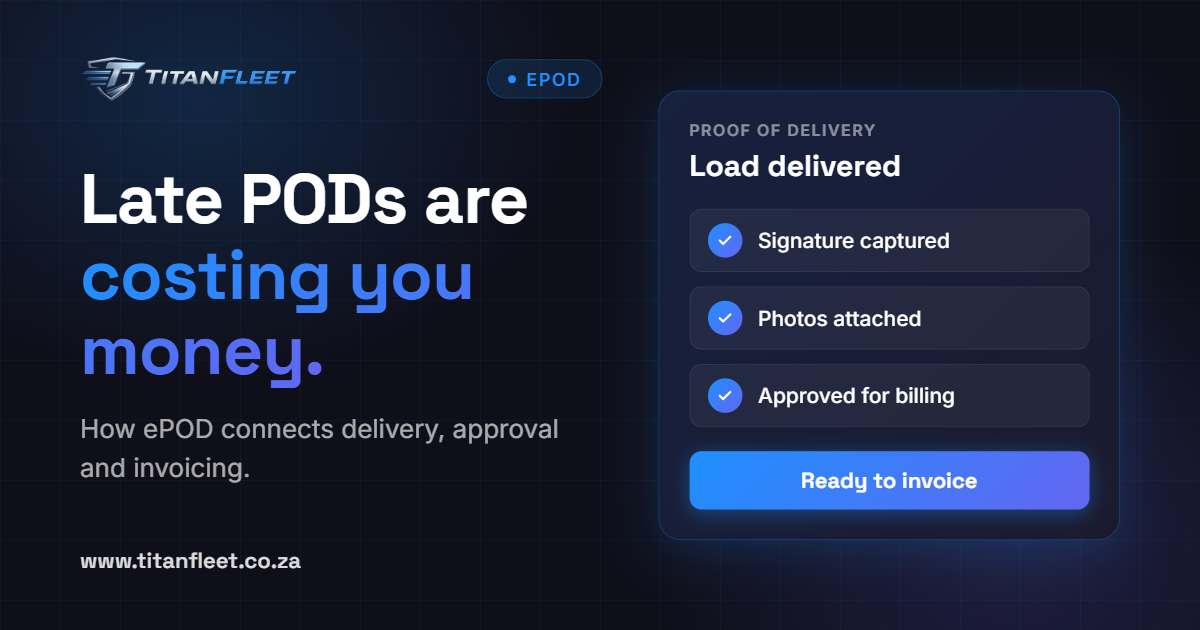
- The driver captures the POD on their phone. Signature, photos, and any notes on damage or shortages are recorded at the moment of delivery, even if the signal is poor, with the app syncing once the driver is back online.
- The office sees it straight away. There is no waiting for paperwork to arrive. The POD is linked to the exact load and delivery.
- It is reviewed and approved. Someone checks the POD before the load is treated as billable, so you are not invoicing on incomplete paperwork.
- The invoice follows from the delivered load. The details are already in the system, so nothing needs to be retyped.
Why connecting ePOD to invoicing matters
Many businesses treat ePOD as a standalone tool: a way to scan or photograph a document. That helps, but the real gain comes when the POD is part of the same system that runs your loads and invoices.
When the POD, the load and the invoice are connected, you can see at a glance which deliveries are complete, which are waiting on paperwork, and which invoices are ready to send. Delivery stops being something you reconcile at month-end and becomes something you can see as it happens.
Not only for operators with their own trucks
ePOD is just as important for businesses that outsource transport. If you manage third-party carriers, you still need proof that each load was delivered before you invoice your customer, and before you settle with the carrier. Capturing PODs digitally across your own fleet and your subcontractors gives you one record of what was delivered and what is ready to bill.
What to look for in an ePOD solution
When you compare options, ask:
- Does the driver capture signatures and photos on a phone, and does it work offline?
- Can damage and shortage be recorded on the spot?
- Is there a review step before a load becomes billable?
- Is the POD linked to the load and the invoice, or is it a separate file?
- Can your customers see their own PODs without calling your office?
- Does it export to the accounting package you already use?
How TitanFleet handles it
TitanFleet is a South African transport management system that treats proof of delivery as part of the whole job, not an add-on. Drivers capture signatures, photos, and delivery notes in the driver app. The office sees them immediately, and each POD is reviewed and approved before the load becomes billable. Invoices then come straight off the delivered load, with export to Sage, Xero or QuickBooks, and your customers can view their loads, PODs and invoices through their own portal.
That is the same system that handles your loads, dispatch, fleet compliance and settlements, so there is one place to see the whole picture, from the booking to the paid invoice.
Start the week without the chasing
If your week ends with a pile of paperwork waiting to be chased on Monday, it may be time to look at how your PODs and invoices connect. We would be happy to show you how it works for your operation.
Book a demo at www.titanfleet.co.za or email info@titanfleet.co.za.